Take a right at the end of Main Street in Lyons where the road forks to the mountains and you’ll see it: a catalpa tree in bloom.

DSC_0570

But this tree isn’t covered in white, frilly flowers. This catalpa blooms with rainbow stripes and crayon blocks of color, a Dr. Seuss tree besweatered in bumpy, shaggy, wavy, nubby yarns knit around its trunk and limbs. If you look quickly enough as you round the corner, you may even spot a small bear flying a kite from her variegated perch.

Julie's Little Lyons Bear

Julie’s Little Lyons Bear

What you’re seeing is a “yarnbombing,” a community’s collaborative endeavor to bring knit art to an unadorned corner of their world. Our sweater tree was the inspiration of Sandra DeVries, a Dutch artist now living in British Columbia. Following projects she’s designed in BC, our tree is her first international yarnbombing effort.

Artist Sandra DeVries

Artist Sandra DeVries

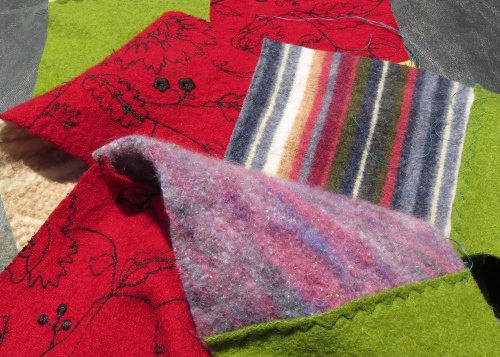
A grant from the Lyons Arts and Humanities Council provided yarn and a stipend for Sandra’s creative management and overall design. Sandra knit the blanket-sized piece for the trunk and other interstitial pieces, while Sandra’s friend, the Dutch artist Jakob Leeuwenburgh, a Lyons resident and Stonebridge member, organized knitters here to create individual pieces in specific sizes matched to a limb or branch of the tree. Each knitter had full artistic license over her swatch, using yarn (or, in one case, recycled sweaters) of her choice.

DSC_0571

Jakob directs the placement of each piece from Sandra’s design

My piece was 28 x 70 and wrapped the crux of the tree where two large limbs emerge from the trunk. 28 x 70 centimeters, that is, something I figured out after I’d knit 28 inches and wondered whether I was making an afghan. Then I remembered that Sandra and Jakob are Dutch and checked with a friend about the measurements. Centimeters went much more quickly.

DSC_0548

Sandy’s swatch before it went on the tree

I chose green eyelash and pom pom yarns from the grant yarns and added my own purple from leftover skeins. To make the yarn go further and the knitting go faster, Jen taught me the drop stitch (wrapping the yarn twice around the needle before making a knit stitch but only picking up one loop of it in the next row, “dropping” it from the needle in a larger, more open weave), perfect on size 13 needles for eyelash yarn that benefits from a looser stitch. In green, that portion of my swatch looks like grass growing in the trunk of the tree.
DSC_0566

My grassy swatch to the left of Jen’s fancy yarn collage

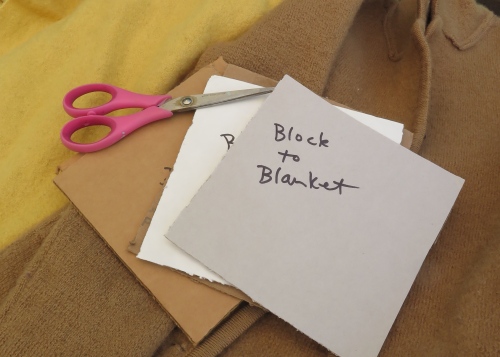
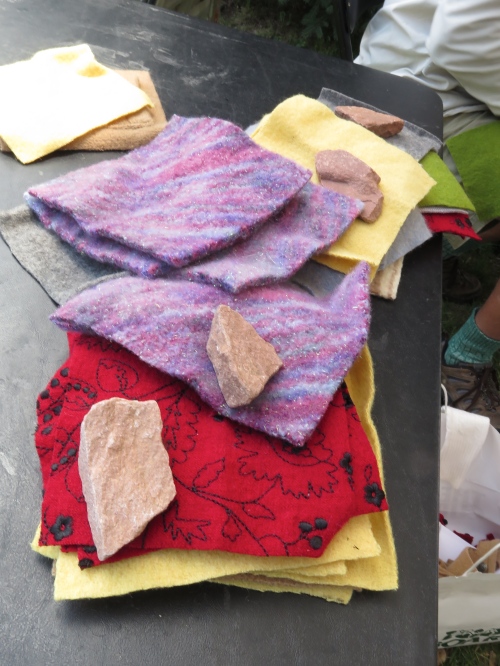
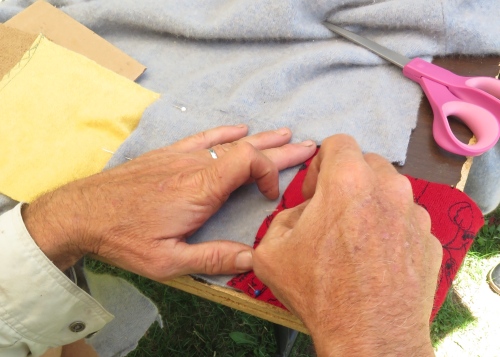
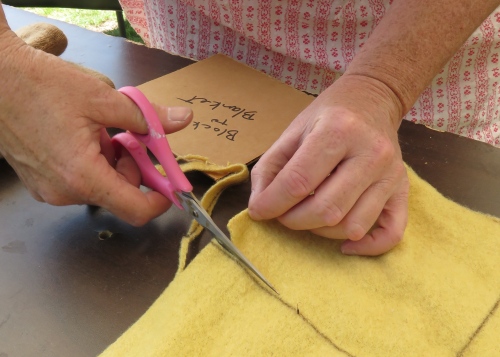
Last Friday, all the knitters met to assemble the tree’s sweater. Following Sandra’s diagram, we stitched our swatches in place around the tree and then attached them to each other to create a finished, seemingly seamless piece that looks like a many-fingered glove. Because the trees are slow to leaf out this cool spring, we had an easy time crawling up in the tree to fit the upper branches.

Jen sewing her multi-patterned piece to the tree.  You can follow her work at songknitter.blogspot.com

Jen sewing her multi-patterned piece to the tree. You can follow her work at songknitter.blogspot.com

In my knitting, I always think of myself as a color person, but, in fact, I love the textures of yarn just as much. As I started whip-stitching my swatch to the tree, I noticed how the dual texture of tree bark and yarn wool beneath my fingers was doubly stimulating and pleasurable to the touch. Yarnbombing a tree, I decided, would be perfect for children, introducing them to a craft and a natural object, synergizing the values of making something by hand and tending the environment in a way that highlights its beauty and function.
Many hands make light work

Many hands make light work

As a community endeavor, yarnbombing combines individual artistic vision and skill with collaborative design and implementation. It unites a group of people with a common goal while allowing for personal expression. Sandra DeVries’ artistry helped us see the tree in a new way, but we each contributed our own ideas to the larger creation.

The group assembles the tree outside the Lyons Fork restaurant

The group assembles the tree outside the Lyons Fork restaurant

Undoubtedly, as with any public art, not everyone will enjoy or approve of yarnbombing a tree, so another aspect of this project’s beauty is its organic nature. Soon a bright green canopy of leaves will integrate the colorful trunk and limbs. As the tree grows and meets the elements, the yarn will fade and fray. Perhaps birds will make their homes in the tree’s branches, unraveling a thread or two for their nests. Eventually, the pieces will blow away or be removed when it gets too bedraggled for public viewing. We’ll see. For now, the tree will get more attention than it ever has before and after its sweater is gone, we’ll remember our tree as the synthesis of art and nature.

DSC_0585

No deep thoughts today, and no time to compose them if I did. Instead, a few pictures to document the farm’s turn from a long winter to a slow spring. With opening day this Saturday, we’re happy to see rain instead of snow. Thunder’s rolling as I write. Soon, raindrops will fall.

Six days ago, our yard was covered in snow.

DSC_0472

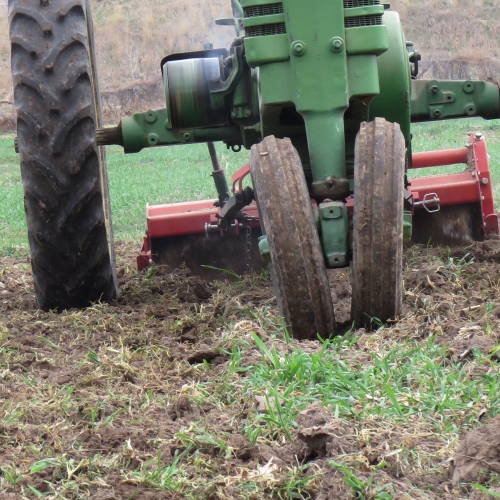
Today, a freshly tilled field awaits planting.

DSC_0535

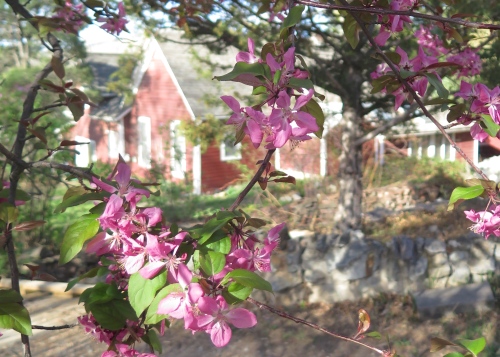
The wild plums are beginning to bud. Nothing smells like spring as wild plum blossoms along the ditches.

DSC_0531

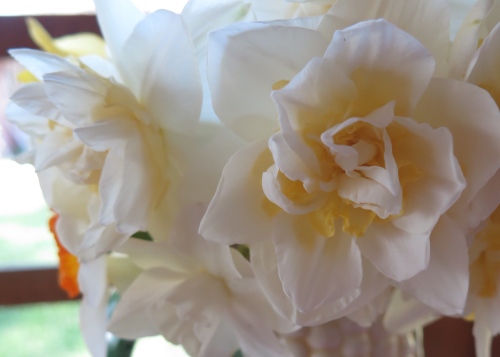
We lost many of our daffodils to snow; the more colorful varieties bloom later and survived.

DSC_0532

A peony unfurls like a tropical flower.

DSC_0539

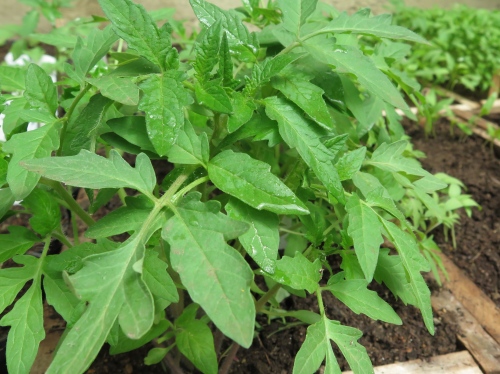
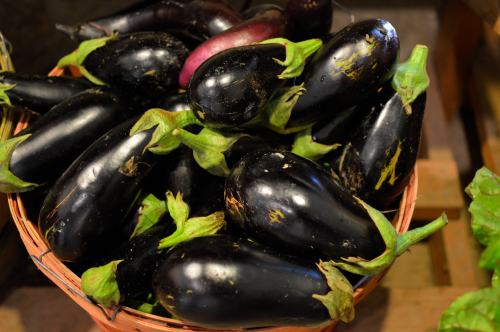
A certain sign of spring is a greenhouse full of tomatoes, peppers, and eggplants.

DSC_0540

The snow gone, John mowed the yard this morning with my Grandpa Short’s push mower.

DSC_0541

And now, the rain begins.

The sun’s out today but we won’t be working in the fields. They’re still blanketed in this week’s super snow, giving me time to post about one of our favorite winter meals, Stonebridge Stuffed Peppers, which we made for last night’s dinner. (While they were baking, the sky turned an amazing shade of blue.)

DSC_0398

The first blue sky we’d seen in days, brilliant blue right before twilight, framing the evergreen and apple trees by the guesthouse, a former chickenhouse.

I wrote about this recipe a year and a half ago because Women Thrive Worldwide, an organization that promotes women’s opportunities and rights in developing countries, included it in their $2 a Day recipe campaign to highlight the fact that millions of people live on very little income—2.5 million on less than $1 a day.  You can view the recipe here on their website or with more pictures here on mine.

The only thing I’d add now is to put ¼ inch of water in the bottom of the pan to help the peppers steam as they bake, especially if you’re making them without some kind of salsa or marinara on top.

We grow our own peppers and the vegetables we use to stuff them. We make a lot of our own cheese. If we didn’t, this recipe would cost more than $2 to make in this country, but it is still a very low cost, healthy meal that can be prepared quickly, is filling, and tastes great the next day too.

DSC_5409

A poblano pepper on the vine. We trellis these peppers because the vines grow four feet high and are filled with peppers.

Stonebridge Stuffed Peppers also takes advantage of how easy it is to freeze peppers, the wonder vegetable of what we call “high summer”—August and September and even into October until the first frost on Colorado’s Front Range. We use poblanos but any pepper with a filling-sized cavity, sweet or hot, will do. To freeze peppers, you can either core them and freeze them whole as shells for winter stuffing or core and slice them to freeze for sautéing in stir fries or sauces. No blanching required. You don’t even need to thaw them before using. Just pull the shells out of their freezer bags and fill. How easy is that?

What also makes stuffed peppers remarkable is that you can fill them with whatever you have on hand. Really. Our filling is usually a quartet of whatever cooked grains/grated or sliced raw veggies/cheese/nuts we have in the fridge and pantry.

DSC_5051

Baskets of poblanos in the barn

If you’ve got the ingredients ready to go, it only takes a few minutes to put this dish together. I’d already cooked the quinoa at lunch, so I threw the ingredients together while John walked out to the bluehouse to get spinach.  Talk about easy. It’s the equivalent of the 1950s casserole but, with its fresh ingredients, much more healthful. I hope you’ll try them! And then let us know: What do you stuff in your peppers?

Note: For people in the Boulder area, Stonebridge is hosting the monthly Mile High food swap this Sunday. You can see a video of last fall’s Stonebridge swap here. We’d love to have you join us so sign up here!

DSC_0389

Here on the Front Range of Colorado, we’re in our second day of a snowstorm that’s bringing much needed moisture—the farmers’ mantra–to our soil and water supply. Even the Huffington Post ran an AP story on our snowstorm, reporting the rise in our snowpack to 77% of normal. That might not sound like good news, but it’s better than it was a week ago. And when I checked the National Resource Conservation Service’s snowpack report this morning, I found even better news: statewide snowpack is 203% of last year (154% for our water basin) when we suffered drought and wildfires. The snow may be below normal but any improvement over last year is welcome.

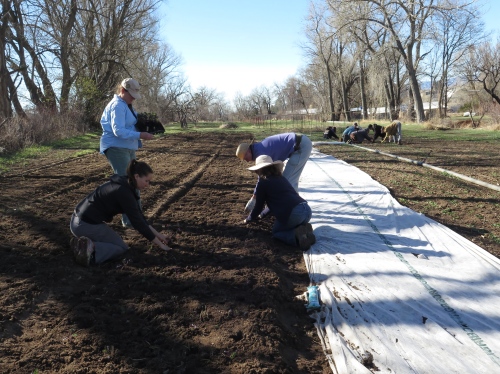
April is a busy time of year for getting vegetables seeded and transplanted, work now delayed by the snow. Two Saturdays ago, we transplanted 7000 onion and leek starts into new beds. With the fields still moist from the smaller snows that followed, we haven’t quite finished that planting. But with a snow day, we can catch up on a few chores that we might not have gotten to otherwise. This morning, John’s repairing our solar lawn mower and I knit a long swatch in assorted yarns for an upcoming public art event (more on that in May). Best of all, this April storm has afforded us time to try our friend Deirdre’s delicious sponge bread, something we’ve been wanting to do for months. Deirdre was right: it’s easy and delicious. I’m glad to have a snow day to find that out.

The snow may not be convenient right now, especially for our loved ones who have to get to work, but we’ll be happy for the snow this summer when there’s water for the fields, and the mountains, we hope, won’t run the risk of wildfire like last summer. A lot will depend on summer heat and wise water use. But for now, the clouds have issued us a reprieve. So here’s a few pics of what “much needed moisture” looks like at Stonebridge.

Snow drifting between our back mudroom and the bunkhouse. Our farmmate Joe tried to sweep a path and broke the broom!

Snow drifting between our back mudroom and the bunkhouse. Our farmmate Joe tried to sweep a path and broke the broom!

The stone bridge in snow

The stone bridge in snow

Typical for a spring snow, the ditch isn't frozen.

Typical for a spring snow, the ditch isn’t frozen

John outside the shop

John outside the shop in the tractor barn where he’s fixing the mower

The curl of snow around the roof of the Sunflower Room porch

The curl of snow around the roof of the Sunflower Room porch

And there's more on the way

And there’s more on the way

DSC_0283When I was teaching at the university, one of the pleasures of spring break for me (besides my birthday) was pruning my roses. Now that I’m retired from teaching there, I still prune my roses about a week after the spring equinox when the stems start to show signs of new growth. As soon as the days start to warm, I watch the roses for swelling where the nodes emerge from the green stems. That way, I can tell which part of the rose has been winter-killed and which is still alive. Waiting a couple weeks more, until the leaves have started to emerge, is recommended along the Front Range, but we get busy with farming in April so late March works best for me.

The last couple days, I’ve been pruning my roses. I used to have more roses but the last few years have been very hard on them. I lost some to drought, some to winter cold, and even a few to voles that love to burrow in the thick wood chip mulch around the rose bushes and sometimes girdle the rose completely through. I think all but one of my roses survived this winter, leaving me with three dozen or so, which I can prune in about three hours.  I look forward all winter to my pruning time in those first sunny days in the flower garden taking stock of what’s survived and what needs attention.

DSC_0288I plant exclusively “own root” roses, which means that the plant has been reproduced from a cutting of its own stock rather than grafted onto the root of another, generally more vigorous, rose stock. Grafted roses offer many more variety choices than own root roses but, if the grafted part dies, the shoots that emerge from the roots will revert to the parent stock, which is usually a ubiquitous shrub type of rose which lacks distinction in bloom. On the other hand, own root roses are slower to grow and bloom than grafted roses but, in our harsh climate along Colorado’s Front Range, I find that own root roses are more likely to survive.

During the busy farming season, I don’t have time to baby my roses, so I grow varieties that are relatively hardy. My favorite roses—and the ones that have done the best in my rose bed—are the David Austin varieties. David Austin is an English rose breeder who combines characteristics of old roses—particularly fragrance and shape—with repeat blooming varieties, resulting in gorgeous, abundant, fragrant roses with outstanding vigor, color, and scent.

My own root varieties of David Austin roses (not all DA roses are own root), have taken a while to get established, but it was worth the wait. My favorite rose is Abraham Darby for its cup-shaped, apricot-pink, multi-petaled flower. If you only grow one rose, it should be an Abraham Darby.

DSC_0007

Another of my favorites is Graham Thomas with its rich yellow blooms. I often avoid yellow roses because, in our dry climate, they tend to turn brown, but Graham Thomas holds its color well.

DSCN0555

Both of these roses are classified as “shrubs,” growing about four feet tall in our climate, so I position them next to short trellises to give some extra support—and I Iike the way their heavy-headed blooms drape across the trellis.

DSC_0018

Other favorites are Lillian Austin, Gertrude Jekyll, Teasing Georgia, Mary Rose, and Othello—but be careful of the warrior thorns on that one because it lives up to its Shakespearean name. I’ve got a space selected this spring for another rose, and I’m anxious to see what our local nursery carries for new David Austin own root varieties.

Some people like to cut their roses all the way down to the ground in the fall or early spring to let new stems emerge from the root graft. But because roses are harder to grow here, I like to wait until I can see what’s dead and alive and then prune only what’s needed.

When I’m pruning, I think about the architecture of the plant. I generally leave only the strongest three or four stems, depending on what’s there, so that the bottom of the bush has a triangular or square shape. Next, I decide where to trim the remaining three or four stems to 10 or 12 inches high by looking at where the nodes emerge and choosing a top node that points in the direction I want the new, emerging branch to go. I always want that new branch to grow away from the center of the plant, meaning it should be found facing the outside of the bush rather than the inside.

Once I choose the node, I remove everything about a quarter-inch above it by pruning at a 45-degree angle up and away from the node. Last, I trim any branches from those main stems by again deciding where I want the new growth to go. As I trim, I try to imagine the architectural shape I want to create and prune accordingly.

DSC_0114

I hope that this spring’s moisture will mean a less severe summer and more abundant roses. Last season, my roses looked miserable and bloomed sparsely. This year, I’m going to feed them more consistently (using Epsom salts dissolved in buckets of water) and make sure they’re heavily mulched. Already, I’ve done a better job pruning than I did last season and that should help.

The most important thing to remember in pruning roses is to wear heavy gloves and long sleeves to protect yourself from thorns. If you’re pruning roses, you will get scratched. That’s part of rose growing–and it’s worth it.

DSC_0045

Following are remarks I made last Friday at the opening reception for the Friedman Feminist Press Collection at Colorado State University, the largest collection of books in the Rocky Mountain West published by feminist presses. Providing original sources in feminist/lesbian literature and second-wave feminism, the collection archives multi-genre works by feminist publishers of the 1960s, 70s, and 80s that brought women and women’s words out into the world.

I want to share these remarks because I hope that the collection will draw students, scholars, and readers to learn more about this important period in second-wave feminist history and its print movement, but also because the collection is dedicated to my friend June Friedman as a legacy to her passionate commitment to the struggle for women’s rights. Thank you to everyone who came to the opening reception last Friday. For further information or to donate to student and scholar outreach and research opportunities for the collection, readers can go to https://advancing.colostate.edu/ffp

FFPAll2

I welcome you all to this dedication of the Friedman Feminist Press Collection at CSU’s Morgan Library. It’s no coincidence that we’re dedicating the collection in March because March is Women’s History Month and the Friedman Feminist Press collection has much to do with women’s history, both for the books that are included and for the woman after whom it is named. Today I’d like to share with you a little bit of those histories.

When I was an undergraduate at CSU in the late 1970s, I spent a lot of time in the basement of the Lory student center. It’s been remodeled, but some of you may remember the big room at the bottom of the stairway where students could eat and study, a room that was ringed by metal cubicles that served as the offices for student organizations. I was a member of one of those organizations, The Feminist Group, a student activist group working to challenge the sexism in those early days of what was then called “women’s liberation.” I loved coming down to the office every day to debate and strategize about how we, a small group of women, could bring about social change, not only on campus, but in the world.

I don’t know what year the group started, but I do remember a framed dollar bill on the wall labeled “Won September 20, 1973.” That was the day Billie Jean King played Bobbie Riggs in a tennis match that was billed the Battle of the Sexes. I loved looking at that dollar every time I went into the office because in September 1973, I was a ninth grader in Ms. Fenniman’s social studies class. Notice I said Ms. Fenniman, because she was a feminist who brought the women’s movement into our study of contemporary social issues and often wore a t-shirt with the audacious slogan “A woman needs a man like a fish needs a bicycle.”

One day after our class discussed the upcoming Battle of the Sexes, the boy sitting behind me bet me that Bobby Riggs would win. I am ashamed to say that although I hoped King would win, I didn’t know much about tennis or about women athletes. If I had, I would have bet against Riggs, an aging, pompous self-promoting has-been, and for Billie Jean King, one of the premiere women athletes of her time. But instead of betting on King, I told the boy behind me that my parents didn’t allow me to bet, which was true but still a really pathetic excuse. Of course, King beat Riggs 6-4, 6-3, 6-3. So every time I saw that dollar bill in the Feminist Group office, I remembered the importance of standing up for my beliefs, whether I thought I could win or not.

As a student group, we did stand up for what we believed in. We published a newsletter, organized women’s film festivals, and wrote guest editorials about campus safety, sexual violence, reproductive rights, gender roles, and the newly flowering field of women’s studies. We organized the first Take Back the Night March in Ft Collins, marching to jeers—and some cheers–past the shady bars downtown in the days before Old Town was re-developed. The activism of which I’m most proud was shutting down a campus Playboy Club in Ingersoll Hall, a so-called student tradition that clearly needed challenging in its sexist representation of women’s roles and rights.

TBNphoto copy 2

A big part of what I learned by these actions was that in standing up for one’s beliefs, an individual voice became even stronger when raised in unison with others. The group embodied the notion of sisterhood, where mutual support and trust inspired us to do things we wouldn’t have taken on alone. We became friends and activists together as we worked to change the sexism in our lives.

One of my closest friends was an out-of-state student named June Friedman. An agronomy major in the early days of women entering the sciences, June understood how gender stereotypes, sexual harassment, and glass ceilings prevented women from achieving their highest goals. With other Feminist Group members and our faculty mentors and role models, June and I worked on what was then called a “chilly climate for women” on campus. As we met in our little office in the basement of the Student Center, we dreamed of a world where women were valued equally with men. We graduated together in 1981 on the soggy field after a rainstorm at Hughes Stadium. And then, a year after we graduated, June’s life was ended by the very kind of violence against which we had marched.

I went on to graduate school, first at CSU for my master’s and then to CU for my PhD. For my dissertation, I decided to examine the books of the early women’s liberation movement, books that had influenced the times in which I had come of age. I focused especially on the development of small-scale feminist presses, publishers that arose in the 60s and 70s because, with the exception of a few high profile spokeswomen like Betty Friedan, Gloria Steinem and Robin Morgan, few feminist and lesbian books were being published by mainstream publishing houses.

FFP4

Now I have to admit that feminism did challenge the very underpinnings of society, so it makes sense from an ideological perspective that feminist books would not be entirely welcomed. That many of the books reflected the lives and perspectives of lesbians made such books even less appealing to male publishers—and the majority of publishers at that time were men.

FFP3

But the rejection of feminist books wasn’t just ideological, it was financial as well. Because male publishers weren’t interested in feminist writing, they didn’t believe such books had a viable sales market. They were wrong, of course, and in their place, the feminist/lesbian presses began to create from the outside a growing market segment for women’s books—books that centered on the rights of women to determine their own destinies—books that began to sell decades before Oprah’s book club championed such plots. And as the feminist presses created a market for those books, the mainstream presses began to notice, so that by 1977, the year I started college, a book like Marilyn French’s The Women’s Room could become a bestseller for Harcourt Brace Jovanovich, particularly in its mass market paperback form.

FFP13

But the difference between the feminist and conventional publishers was that the women’s press movement not only pushed the edge of mainstream publishing, but also formed an essential arm of the growing women’s movement, furthering activism committed to the larger political and social changes that have advanced women’s lives. The feminist presses understood that getting women’s words into print and seeing women’s lives reflected in books was liberatory. The slogan of Oakland’s A Woman’s Place Bookstore, the first women’s bookstore in the US, was “A woman’s place is in the world” and Louise Knapp, our speaker today, named her bookstore “Word is Out.” Being “out” in the world meant many things: claiming one’s sexual identity, gaining access in employment, politics, and education, and encouraging young women to think of a future beyond and beside marriage and family. Most of all, getting women out into the world meant making a difference in that world and the books carried in these bookstores helped bring that idea to life.

Similarly, I titled my dissertation Out into the World: The Print Evolution of Feminist Revolution. Here I talked about women who took it upon themselves to buy paper and ink and learn how to run off-set presses and hold women in print conferences and create distribution networks, newsletters, and catalogs and drive vans with cartons of books cross-country and open bookstores to sell the books the feminist presses had produced.

FFP1

I talked about books like Woman to Woman, the first all-woman anthology every published, printed by poet Judy Grahn and artist Wendy Cadden as the Free Women’s Press in San Francisco in 1970 on a mimeograph machine with onion-skin pages that sold for $1.50; and books like True-to-Life Adventure Stories published by Diana Press, which started in Baltimore and merged with The Women’s Press Collective in Oakland and run by women who, according to Judy Grahn, cut their hair when it kept getting caught in the press.

I wrote about Cherie Moraga’s This Bridge Called My Back, recovered by Kitchen Table: Women of Color Press after the white women’s press that had originally published it went into debt and out of business; and about Rita Mae Brown’s Rubyfruit Jungle, published by Daughters, Inc. in 1973, which was such a runaway bestseller, Daughters sold the paperback rights in 1977 to Bantam, a corporate publisher who by then had seen the dollar signs, sparking a debate within the feminist print movement about “selling out” and the value of mainstreaming feminist books. Some of those publishers are still with us, while others published just a few influential works, but all of those books circulated within the women’s movement and led to the changes that shape society today.

FFP11

In the process of my dissertation research, I collected books published by independent feminist presses. I found them in used bookstores, feminist publications, and a women’s book catalog called Luna Books. It became quite a collection and I realized that others could benefit from access to it. Now, almost twenty years after I finished “Out into the World,” that collection will be “out into the world” here at CSU, along with books contributed by Foula and the GLBT center, as the Friedman Feminist Press Collection in memory of my friend June.
FFPshelf

I can’t think of a more appropriate place for books that evoke the feminist activism June embodied. Like the courageous, generous, and adventurous women who established these presses, June lived her beliefs. She was a feminist who loved nature and books and had a bright future as an agronomist here in Colorado. We miss her dearly.

I hope you all have a chance to visit and read and use and recommend these books in the years to come. Bring your students; assign papers and projects; get other scholars interested; donate to fund outreach and research opportunities; and just come and pick up a book to experience the delightful, controversial, inspirational, and radical words written by feminist authors and published by feminist presses. I hope these books continue to bring women and women’s words out into the world, pushing the boundaries of what it means to be free.

In closing, I’d like to share another memory of June. While we were students here at CSU in the late 70s, June and I organized a women’s book group that met for potlucks in the basement apartments we rented in those days. I only remember two of the books that we read. One was The Women’s Room, which I mentioned earlier, and the other was Monster, a poetry collection by Robin Morgan, a book that seemed to bite right into the side of the patriarchy we opposed. In dedication of the Friedman Feminist Press Collection to June, here is an excerpt from Morgan’s poem “Letter to a Sister Underground.” I hope you will take it in the spirit of 1970s feminist social change in which it was written:


How to close such a message?

I miss you.

We are all as well as can be expected.

Hope you are fine and

having a wonderful time.

Don’t send a picture postcard when you can.

Stay hidden.

Come back to us.

We’ll join you.

Don’t accept rides from strange men,

and remember that all men are strange as hell.

Think of us sometime, my sister,

Forget us, my friend.

Watch for me when you look in the mirror;

I see you all the time.

Take care of ourselves.

See you soon.

FFPAll

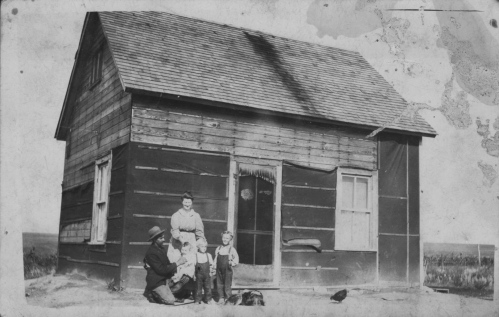
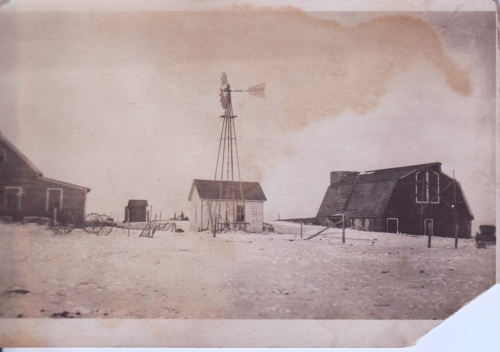
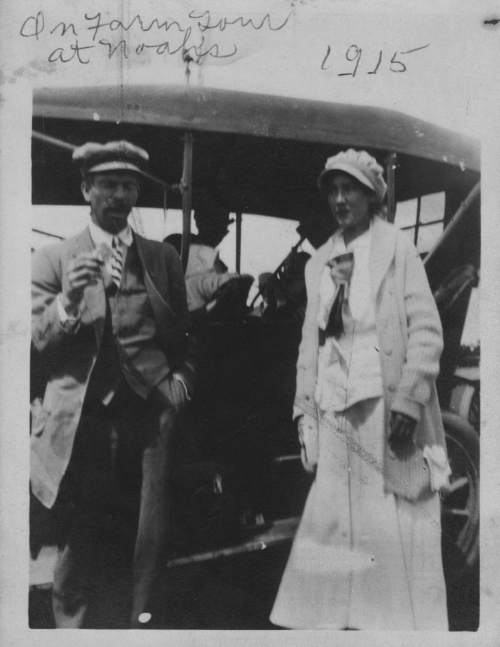
I’m drying apples today, which sounds a little strange in March, but I still had some organic winter keeper apples from Ela Farms in our cool room that were in great condition for drying, the skins only slightly shriveled or “pre-dehydrated,” and the fruit inside still fresh and firm. As I cored and sliced them, I noticed that my apple rounds were irregular widths, reminding me that I’m a human being, not a machine. I thought about how my grandparents and great-grandparents farmed before automation when farm work meant doing things by hand or with simple machinery operated by hand. How different than work in mechanized factories or sitting behind a computer screen.

My great-grandfather Jasper Smith and great-aunt Myra harvesting wheat

My great-grandfather Jasper Smith and great-aunt Myra harvesting wheat

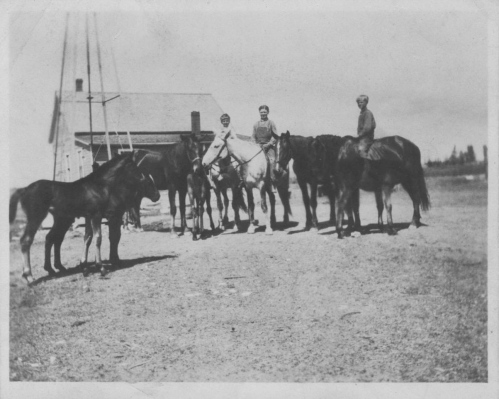
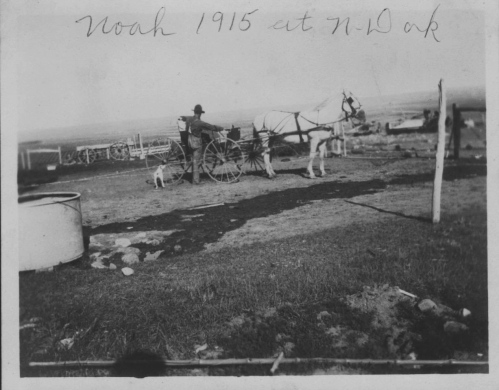
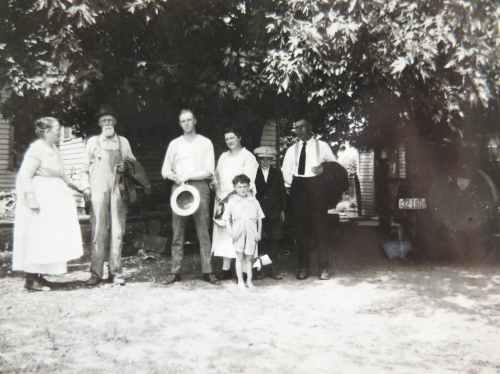
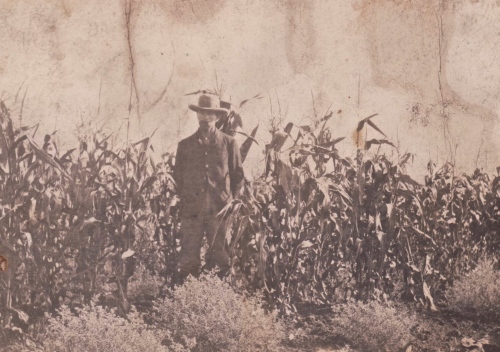
I don’t mean to idealize those days. Farming back then was bone-wearying hard, whether raising crops and livestock or putting food on the family table.  After all, my apples were drying in an electric dehydrator and I had running water to prepare them, not water hand-pumped from a well. But when I do things by hand, I remember my grandparents’ farms when I was growing up and I feel a kinship to my farming past. I think my grandparents felt a satisfaction with the work they did because the results benefitted them directly: wholesome food raised on land they had homesteaded, milk and eggs to sell in town, and a full granary of wheat to provide for the things they couldn’t raise.

My great-grandmother Flora Hunsley Smith raising turkeys

My great-grandmother Flora Hunsley Smith raising turkeys

A couple weeks ago, our county invited farmers to a special dinner and presentation by several farmers, now in their seventies and eighties, whose families had been farming for a hundred years or more on land where, according to one speaker, “everything is houses now.” They shared photographs of their families raising beet, alfalfa, and wheat crops and, just like my father, they knew the make, model, and year of every tractor they had driven. Back then, they said, companies like Case, John Deere, Oliver, and International all had businesses in town, none of which remain today.

My dad in his teens with his John Deere A.

My dad in his teens with his John Deere A.

These families had farmed before the “Get Big or Get Out” agriculture of the 1980s, when high interest loans for machinery and land shaved the profit margin so slim that only large-scale farms had a chance to survive. Back then, they said, “a lot of families farmed a little bit of land” instead of “just a few big farms” owning more of it. My partner John remarked to me that, judging from the photos, those little farms still provided enough income to build big farmhouses and barns. And, as one of the farmers remarked, family farms also “raised an awful lot of what you ate.” Since “the ladies canned all summer,” only sugar, salt and coffee were purchased. One farmer shared that he had recently found a Ball jar of pears from 1931 in his cellar—and it was still good.

Jars like my grandmothers used to can and keep in their root cellars

Jars like my grandmothers used to can and keep in their root cellars

All the farmers agreed that farming nowadays isn’t like farming was then, but they weren’t just referring to the economics of it. Instead, they remembered how families worked together to get the crops in and how people could do business on the trust of a handshake instead of a contract. Having seen the end of their way of life, they were glad for the chance to have lived it.

Grandpa Short with his Minneapolis Moline G

Grandpa Short with his Minneapolis Moline G

Last week, a friendly couple stopped by our farm. They had lived here in the early 1970s as part of a commune, of sorts, although the woman laughed that she hadn’t known she was a hippie until she’d read an article describing one. In the 70s, it didn’t take much to be considered a hippie; the “back-to-the-land” movement was branded countercultural as young people “dropped out” by rejecting middle-class jobs and keeping up with the neighbors.

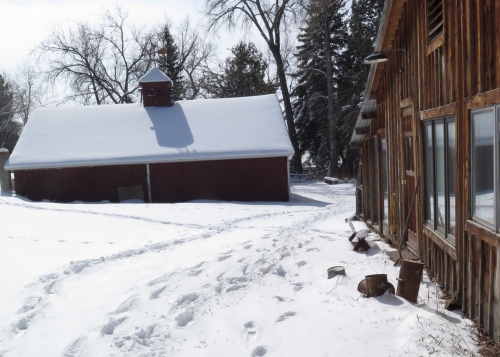
As part of that movement, our visitors had milked two cows in what is now our community room, raised chickens in the old chicken house that’s now our guesthouse, and made candles and leather goods in the barn where we now distribute the vegetables for our CSA. John and I enjoyed walking around the farm with the couple and learning some of Stonebridge’s history. The cows were pastured where we now grow our vegetables—no wonder it’s so fertile. Their tipi stood in the old orchard where, twenty-five years later, our friends had raised a tipi for a while. And I was thrilled to hear that the Paul Butterfield Blues Band had jammed in our very own living room!

The Stonebridge John Deere B

The Stonebridge John Deere B

I’m not surprised at this farming past. Stonebridge has a “vibe” for community, whether commune or CSA. I’m glad to trace our farm as part of the “back-to-the-land” movement of young people whose own parents had fled the hardships of farming after WWII. Something had been lost in that migration, something that the small farms of my grandparents and the older farmers in our county had provided: a sense of working together for a common good rather than merely profit, a sense of being human rather than a machine. Many of us in small-scale farming today are looking for that same sense of community and satisfaction in work well done with others, for others. As Stonebridge begins our 22nd season, we are thankful for a farming past that we hope ensures a farming future.

Saturday morning pick at Stonebridge

Saturday morning pick at Stonebridge

For more about the connections between farms of the past and small-scale farming and CSA today, see my forthcoming book, A Bushel’s Worth: An Ecobiography, published by Torrey House Press.

Follow

Get every new post delivered to your Inbox.

Join 56 other followers